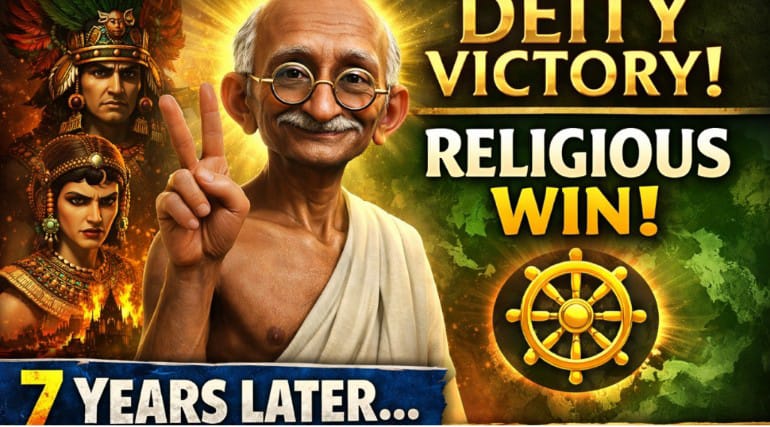
For the past seven years, I had one small but stubborn challenge in the back of my mind:
Win a Deity game in Civilization VI as Gandhi.
Anyone who has played on Deity difficulty knows what that means. The AI starts with massive advantages — extra settlers, technologies, and production. On paper, the odds are heavily against the player.
But that’s exactly why it fascinated me.
I kept thinking:
If the game is built on systems and logic, then there must be a way to beat it.
And if there is a way, then it is only a matter of finding the right strategy.
Years of Failed Strategies
Over the years, I tried multiple approaches. Many looked promising in theory but collapsed in practice.
Military Strategy
My first instinct was simple: fight fire with fire.
I tried to rush military units early and expand aggressively.
The result was predictable.
On Deity, AI civilizations start far ahead. While I was building my first army, they already had stronger units and better infrastructure. Wars drained resources, cities fell behind, and the game spiraled out of control.
Lesson learned:
On Deity, trying to out-muscle the AI early is often a losing battle.
Scientific Strategy
Next came the science victory approach.
The idea was to play defensively, focus on campuses, and outscale the AI later in the game.
But again, reality was different.
The AI’s early advantage meant they were already racing through technologies. Even when I optimized my cities, I was constantly trying to catch up rather than lead.
The game became a slow uphill climb that rarely ended in victory.
Balanced Strategy
Then I tried the “balanced empire” approach.
A little science.
A little military.
Some culture.
This strategy felt safe, but it also lacked focus. Without specializing in a win condition early, the AI would always outpace me in at least one domain.
The result: mediocrity everywhere, victory nowhere.
The Breakthrough: A Religious Victory
After years of experimenting, I finally shifted my mindset.
Instead of trying to compete with the AI in everything, I focused on one clear path.
A religious victory.
With Gandhi, the choice suddenly made sense. His civilization bonuses strongly support religious gameplay. Instead of fighting the game mechanics, I decided to lean fully into them.
The strategy was simple in concept but required careful execution:
- Rush Holy Sites early
- Secure a strong religion
- Generate faith consistently
- Spread religion strategically instead of randomly
- Avoid unnecessary wars
- Control religious pressure and apostles efficiently
This time, everything aligned.
Cities developed smoothly. Faith production grew rapidly. Missionaries and apostles started converting entire civilizations.
One by one, the world followed my religion.
And finally, after seven years of attempts, the victory screen appeared.
Religious Victory. Gandhi. Deity difficulty.
Why This Win Meant More Than Just a Game
This wasn’t just about winning a strategy game.
It was about something deeper.
For years, I had this thought in my head:
If I cannot solve this problem, then maybe my logical thinking is flawed.
But today proved something important.
The issue was never logic.
The issue was simply finding the right approach.
And that idea applies far beyond gaming.
The Same Mindset in My Professional Work
As a backend engineer with more than a decade of experience, problem-solving is the core of my daily work.
Systems fail.
Performance drops.
Architecture becomes complex.
Unexpected issues appear in production.
But the principle is always the same:
There is always a solution.
Sometimes it takes:
- deeper analysis,
- multiple failed attempts,
- or completely rethinking the approach.
But eventually, the right path reveals itself.
This mindset has shaped the way I approach software engineering:
- Logical thinking to break down complex problems
- Persistence to keep experimenting with solutions
- Leadership to guide teams through uncertainty
- Confidence to know that difficult problems are solvable
The same persistence that kept me trying different strategies in Civilization VI is the same persistence I bring to coding, architecture decisions, and technical leadership.
Never Giving Up
Seven years is a long time to keep trying something.
Most people would simply move on.
But I’ve always believed in a simple rule:
If something can be solved, I will solve it — sooner or later.
And today, that belief paid off.
Not just with a Deity victory as Gandhi, but with a reminder of the mindset that drives everything I do.
What I say, I achieve.
Maybe not immediately.
Maybe after many failed attempts.
But sooner or later — I get there.
And most importantly,
I never give up.